

Kingston FURY Renegade Pro DDR5 RDIMM for AI Workstations
Published 16th July 2026 | Article by MemoryCow | Posted in DRAM/Memory
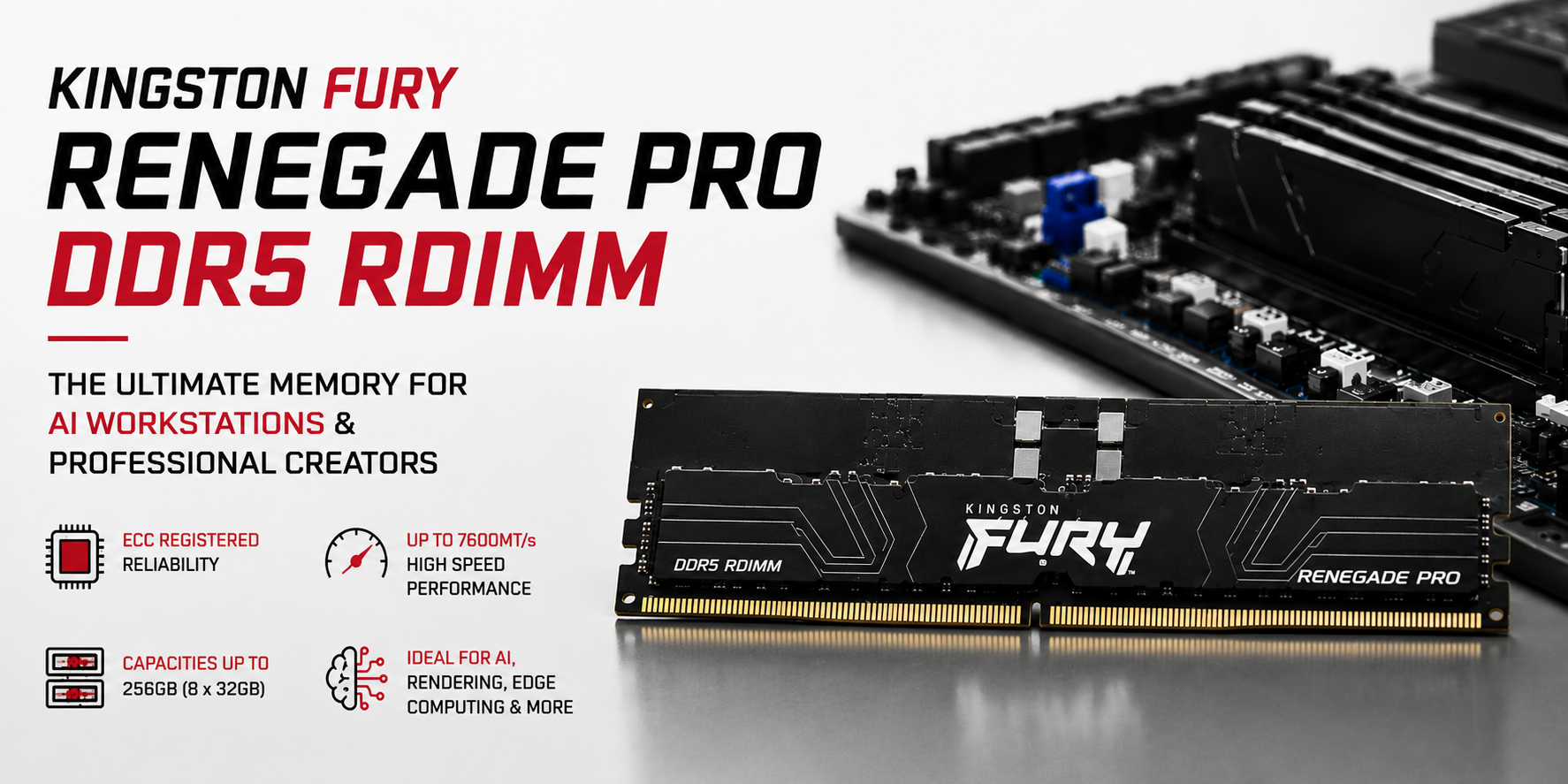
Kingston FURY Renegade Pro DDR5 RDIMM: The Ultimate Workstation Memory for AI & Professional Creators
Artificial intelligence, high-resolution video production, 3D rendering and advanced engineering applications are placing greater demands on professional workstations than ever before. While processors and graphics cards receive much of the attention, system memory plays an equally important role in keeping demanding projects responsive, stable and productive.
Kingston FURY Renegade Pro DDR5 RDIMMs have been designed for users who need the performance associated with enthusiast-grade memory alongside the dependability of server-class ECC Registered memory. It is an excellent choice for AI developers, animators, video editors, engineers, data scientists and other professionals building high-end desktop or workstation systems.
With high DDR5 data rates, Intel XMP 3.0 and AMD EXPO profile support on selected modules, ECC protection and capacities reaching 256GB in matched kits, Kingston FURY Renegade Pro gives workstation users the speed and memory bandwidth required for modern professional workloads.
What Are Kingston FURY Renegade Pro DDR5 RDIMMs?
Kingston FURY Renegade Pro is a range of high-performance DDR5 Registered DIMM memory created for compatible workstation and high-end desktop platforms. It bridges the gap between conventional server memory and performance-focused desktop RAM.
Standard desktop memory is normally supplied as an Unbuffered DIMM, commonly known as a UDIMM. Workstations based on platforms such as AMD Ryzen Threadripper PRO or selected Intel Xeon processors may instead require Registered DIMMs, or RDIMMs for short/abbreviation.
An RDIMM includes a register between the memory controller and the DRAM components. This helps reduce the electrical load placed on the memory controller, improving stability when multiple modules and large memory capacities are installed. That makes RDIMM technology particularly valuable in systems expected to operate under sustained professional workloads.
Kingston FURY Renegade Pro enhances this workstation-focused design with high memory speeds and preconfigured performance profiles. The result is memory suited to users who want strong bandwidth without sacrificing the data integrity expected from professional hardware.
Why Workstation Memory Matters for Artificial Intelligence
AI workloads can consume a substantial amount of system memory. The precise requirement depends on the model, dataset, software environment and available GPU memory, but insufficient RAM can quickly become a bottleneck.
System memory may be used to load datasets, prepare training batches, run development tools, cache frequently accessed information and support data transfers between storage, the CPU and one or more GPUs. When available RAM is exhausted, the operating system may begin using much slower storage-based virtual memory, reducing responsiveness and extending processing times.
A high-capacity DDR5 RDIMM configuration can help an AI workstation:
- Load and process larger datasets.
- Run local large language models and supporting applications.
- Prepare data for GPU-based training and inference.
- Operate multiple virtual machines or containers.
- Run notebooks, databases and development environments simultaneously.
- Reduce reliance on slower storage-based swap files.
- Maintain smoother performance during long-running AI tasks.
More memory does not automatically make every AI model compute faster, and it cannot replace GPU VRAM. However, sufficient system RAM helps keep the complete workflow moving efficiently and prevents avoidable slowdowns outside the GPU itself.
Ideal for Local AI and Large Language Models
Interest in running AI models locally continues to grow. Businesses, researchers and creators may prefer local processing for privacy, lower recurring cloud costs, greater control or access to models in environments with limited internet connectivity.
Local language-model applications can require significant system RAM, especially when models are partially or entirely loaded outside GPU memory. Quantisation can reduce the memory footprint, but larger models, extended context windows and multi-user environments still benefit from generous memory capacity.
A workstation equipped with 128GB or 256GB of Kingston FURY Renegade Pro DDR5 RDIMM can provide considerably more working space than a conventional 32GB desktop. This is useful for local inference servers, retrieval-augmented generation systems, vector databases, document processing and AI-assisted software development.
Large memory capacity also allows users to keep supporting tools open while an AI workload is running. A developer may need an integrated development environment, browser tabs, Docker containers, data-preparation scripts, monitoring tools and a local database at the same time. Adequate RAM keeps these processes from competing unnecessarily for limited resources.
AI Image Generation, 3D Rendering and Visual Effects
AI image generation and professional rendering workflows can place heavy demands on both GPU memory and system memory. Applications used for generative imaging, animation, simulation and visual effects frequently handle large assets, complex scenes, high-resolution textures and extensive caches.
Kingston FURY Renegade Pro DDR5 RDIMMs are well suited to workstations running software and workflows involving:
- Stable Diffusion and node-based image-generation interfaces.
- Blender modelling, animation and rendering.
- Autodesk Maya and 3ds Max.
- Cinema 4D.
- Unreal Engine virtual production.
- CAD and product visualisation.
- Scientific and engineering simulation.
- Compositing and visual-effects software.
During rendering, system RAM may store scene geometry, textures, simulation data and application caches. Complex projects can exceed the comfortable limits of ordinary desktop memory configurations. Increasing capacity can allow larger scenes to remain in memory, improve multitasking and reduce the interruptions caused by memory exhaustion.
High DDR5 bandwidth is also valuable when large quantities of data must move through a multi-core workstation. On platforms offering four-channel or eight-channel memory architectures, installing matched modules across the recommended channels can provide substantially greater aggregate bandwidth than a mainstream dual-channel desktop.
Professional Video Editing and Content Creation
Modern video projects are becoming increasingly memory intensive. Editors may work with 4K, 6K or 8K footage, high-bitrate codecs, multiple camera angles, complex colour grades and layered visual effects. At the same time, AI-powered features such as object isolation, speech enhancement, automatic transcription and frame generation can add further processing demands.
A high-capacity workstation memory configuration can improve the experience in applications such as Adobe Premiere Pro, After Effects, DaVinci Resolve and professional digital-content suites. More available memory can help with timeline caching, background rendering, large compositions and switching between several creative applications.
For example, a creator may have a video editor, motion-graphics package, image editor, audio workstation and browser-based review platform open simultaneously. A 128GB or 256GB memory configuration gives these applications more room to operate without constantly moving data to and from storage.
This can be particularly valuable for studios where workstation time directly affects project turnaround and client delivery schedules.
ECC Registered Memory for Professional Reliability
Performance is important, but professional workstations also need reliability. Kingston FURY Renegade Pro uses ECC Registered DIMM technology to help protect data integrity and support stable operation.
ECC, or Error-Correcting Code, memory can detect and correct certain memory errors before they affect an application or operating system. Although memory errors are uncommon, the potential consequences can be significant when a workstation is running a long render, scientific calculation, AI training job or business-critical project.
ECC memory is not a substitute for backups, verified storage or sensible data-protection procedures. It is an additional layer of protection that can reduce the risk of certain memory-related errors affecting results or system stability.
The registered design is also important when building systems with several memory channels and large capacities. By reducing the electrical load on the memory controller, RDIMMs make it practical for compatible workstation platforms to support configurations beyond the limits normally associated with mainstream desktop memory.
DDR5 Performance and Available Speeds
Kingston FURY Renegade Pro DDR5 RDIMMs are available in a range of performance levels, including speeds from 5600MT/s through to 7600MT/s, depending on the module, kit and supported platform.
Available speed options within the wider range include:
- DDR5-5600.
- DDR5-6000.
- DDR5-6400.
- DDR5-7200.
- DDR5-7600.
The referenced 128GB Kingston kit, model KF572RH38RBK4-128, contains four 32GB modules rated at 7200MT/s with CL38 latency, ECC Registered operation and Intel XMP profiling.
It is important to understand that the maximum achievable memory speed depends on the processor, motherboard, BIOS, number of installed modules and memory-channel configuration. Installing additional modules or using higher-capacity configurations may reduce the supported operating speed.
Performance profiles are technically overclocking profiles. Users should consult the processor and motherboard documentation before enabling Intel XMP or AMD EXPO, especially when stability is more important than maximum benchmark performance.
Module and Kit Capacities
Kingston FURY Renegade Pro DDR5 RDIMM provides capacity options for both focused professional builds and heavily equipped multi-channel workstations.
| Configuration | Total Capacity | Typical Use |
|---|---|---|
| 1 x 16GB | 16GB | Testing, replacement or targeted upgrades |
| 1 x 32GB | 32GB | Individual module upgrades |
| 4 x 16GB | 64GB | Quad-channel creator workstations |
| 4 x 32GB | 128GB | AI, rendering and advanced content creation |
| 8 x 16GB | 128GB | Eight-channel bandwidth-focused workstations |
| 8 x 32GB | 256GB | Large AI models, simulation and virtualisation |
Matched kits are generally preferable when building a multi-channel workstation because the modules are supplied together for a consistent configuration. Users should avoid mixing different part numbers, capacities, ranks or performance profiles unless the motherboard manufacturer explicitly confirms support.
Compatible Workstation Motherboards and Platforms
Kingston FURY Renegade Pro DDR5 RDIMMs are not compatible with ordinary DDR5 UDIMM desktop motherboards that require Non-ECC or ECC memory. The motherboard and processor must specifically support DDR5 ECC Registered DIMMs.
Potential platforms include selected professional and workstation motherboards from manufacturers such as:
- ASUS: including compatible Pro WS workstation boards for AMD Ryzen Threadripper PRO and Intel Xeon platforms.
- Gigabyte: including selected WRX90 workstation motherboards and professional workstation systems.
- Supermicro: selected workstation and server-class boards supporting the correct DDR5 RDIMM type.
- MSI: selected professional workstation platforms where DDR5 RDIMM support is explicitly listed.
- ASRock Rack: compatible workstation and server motherboards designed for ECC Registered memory.
For example, the ASUS Pro WS WRX90E-SAGE SE and Gigabyte MH53-G40 provide eight DDR5 RDIMM slots and an eight-channel architecture for compatible AMD Ryzen Threadripper PRO processors. These types of platforms are designed for multi-GPU workstations, professional expansion cards and memory-intensive workloads.
Never assume compatibility based only on the presence of a DDR5 slot. DDR5 UDIMM, ECC UDIMM, RDIMM, 3DS RDIMM and MRDIMM products are different memory types and are not universally interchangeable.
Before ordering, check:
- The exact motherboard model and revision.
- The installed processor and its memory controller.
- The motherboard memory support list or QVL.
- Supported RDIMM capacity, rank and DRAM density.
- The recommended slot population order.
- Supported speeds with four or eight modules installed.
- Whether the required XMP or EXPO profile is supported.
- Whether a BIOS update is recommended.
Edge AI and Edge Computing
Edge computing moves data processing closer to the location where information is generated. Instead of sending every task to a remote cloud platform, an edge workstation or server can process information locally.
This approach is increasingly relevant to manufacturing, medical imaging, security, robotics, retail analytics, media production and scientific research. Edge AI systems may analyse camera feeds, sensor information or operational data while maintaining low latency and reducing the amount of information transmitted externally.
Memory capacity is important because an edge system may need to run an inference engine, database, message queue, monitoring platform and several containerised services simultaneously. Kingston FURY Renegade Pro DDR5 RDIMM can provide the capacity and bandwidth required for powerful edge workstations where performance, local control and reliability are priorities.
ECC protection is particularly useful for systems operating continuously or in professional environments where an unexpected error could interrupt processing or affect results.
Virtualisation, Engineering and Scientific Computing
The advantages of high-capacity RDIMM memory extend beyond AI and media creation. Engineers, architects, researchers and IT professionals frequently run workloads that benefit from large, reliable memory pools.
Virtualisation is a clear example. Every virtual machine requires an allocation of system RAM, while the host operating system and management tools need memory of their own. A 256GB workstation can support substantially more development, testing or isolated production environments than a system limited to 32GB or 64GB.
Computer-aided engineering, finite element analysis, computational fluid dynamics, geographic information systems and electronic design automation can also generate large working datasets. Although performance varies by application, sufficient memory helps prevent these datasets from overflowing into slower storage.
How Much Workstation Memory Do You Need?
The best capacity depends on the applications being used and the size of the projects involved.
- 64GB: suitable for many professional editing, CAD, programming and moderate rendering workflows.
- 128GB: a strong choice for advanced video production, AI development, large scenes, multi-application creative work and several virtual machines.
- 256GB: ideal for larger local AI models, complex simulation, heavy virtualisation, high-end visual effects and memory-intensive research workloads.
Consider peak memory usage rather than average usage. A system that normally consumes 70GB may still benefit from 128GB if larger projects regularly push it beyond 100GB. Allowing additional headroom can also accommodate future software updates and more demanding projects.
Why Choose Kingston FURY Renegade Pro DDR5 RDIMM?
Kingston FURY Renegade Pro stands out because it combines characteristics that are rarely found together in conventional desktop memory:
- High-performance DDR5 speeds.
- ECC Registered DIMM reliability.
- Intel XMP 3.0 or AMD EXPO support on selected products.
- Single modules and matched four-module or eight-module kits.
- Capacities reaching 256GB per kit.
- Configurations designed for multi-channel workstation platforms.
- A low-profile thermal design suitable for densely equipped systems.
- Kingston lifetime warranty coverage.
For users building a system around a compatible AMD Ryzen Threadripper PRO or Intel Xeon workstation platform, it offers an attractive balance of bandwidth, capacity and reliability.
Final Thoughts
Professional computing is changing rapidly. AI development, local inference, 8K video, virtual production, simulation and edge computing all require systems capable of moving and storing enormous quantities of data.
Kingston FURY Renegade Pro DDR5 RDIMM gives compatible workstations the memory bandwidth and capacity needed to meet these demands while retaining the stability and error correction associated with professional ECC Registered memory.
Whether you are building a 128GB AI development workstation, a 256GB rendering system or a multi-GPU platform for scientific computing, choosing the correct memory configuration is essential. Always verify the exact motherboard, processor, BIOS and QVL before purchasing, then install matched modules according to the manufacturer’s recommended memory-channel layout.
Explore the range of Kingston FURY Renegade Pro DDR5 RDIMM memory at MemoryCow, including single modules and matched kits for compatible professional workstations.
Frequently Asked Questions
Is Kingston FURY Renegade Pro DDR5 RDIMM suitable for AI?
Yes. It is well suited to compatible AI workstations that require large memory capacities, high bandwidth and ECC reliability. The ideal capacity will depend on the model, dataset, GPU configuration and supporting applications.
Can I install DDR5 RDIMM memory in a standard desktop motherboard?
No. Most mainstream desktop motherboards use DDR5 UDIMMs and do not support Registered DIMMs. Both the processor and motherboard must explicitly support DDR5 RDIMM memory.
What capacities are available?
The range includes 16GB and 32GB single modules, four-module kits providing 64GB or 128GB, and eight-module kits providing 128GB or 256GB.
Does Kingston FURY Renegade Pro support ECC?
Yes. It is ECC Registered memory designed to provide the reliability and data-integrity benefits required by compatible professional workstation platforms.
Will 7200MT/s memory always operate at 7200MT/s?
No. The final operating speed depends on the processor, motherboard, BIOS, module capacity, number of installed DIMMs and enabled memory profile. Check the motherboard QVL and platform documentation before purchase. This is applicable for any memory frequency.