

Authority: Edge AI Systems
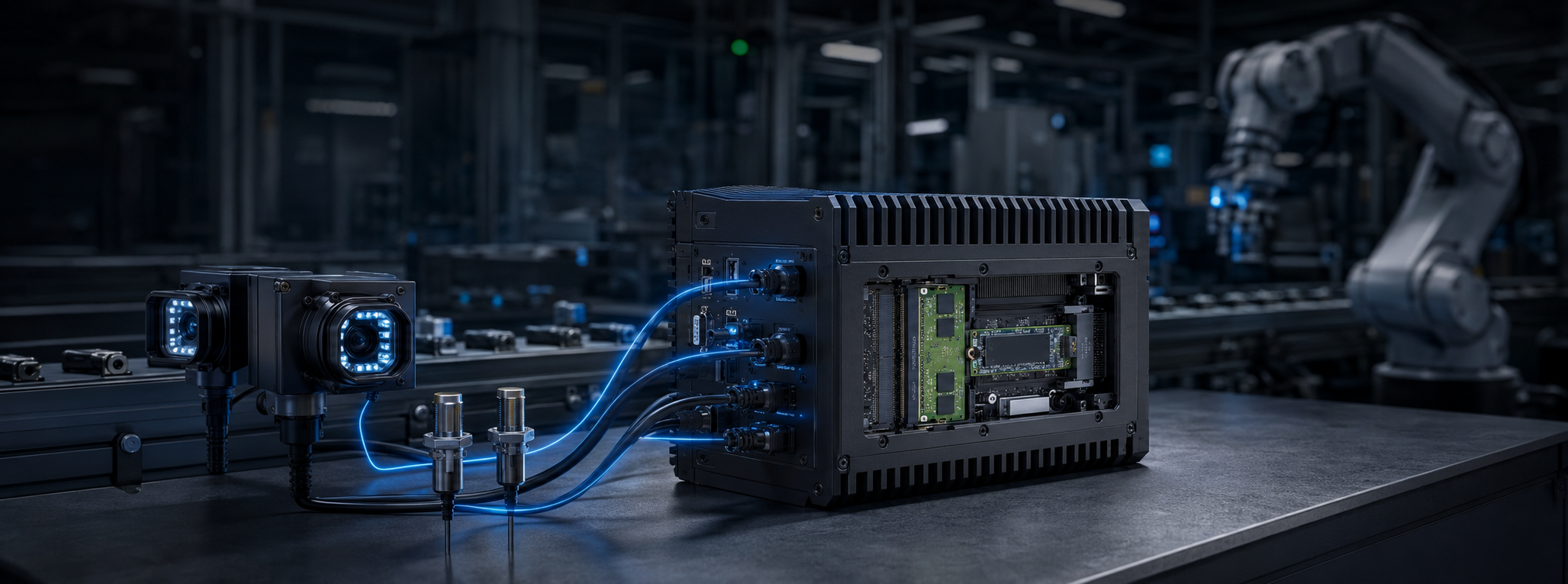
Edge AI Systems: DRAM, SSD and Hardware Guide
Edge AI systems run artificial intelligence close to where data is created instead of sending every task to a remote cloud or central data centre. They can analyse camera feeds, sensor readings, audio and operational data locally, allowing equipment to make decisions or generate alerts with minimal delay.
From smart factories and retail analytics to medical equipment, robotics and transport, Edge AI is changing how organisations use data in the physical world. Its hardware can range from a compact embedded module to a rugged industrial computer or powerful on-site edge server. Each format places different demands on the processor, accelerator, DRAM and SSD.
This guide explains what Edge AI systems do, the hardware they use and how to choose suitable memory and storage. Where components are upgradeable, MemoryCow can help identify compatible RAM, ECC and server memory and solid-state drives.
Important: some embedded Edge AI devices use soldered LPDDR memory or integrated flash storage that cannot be upgraded. Industrial PCs, embedded x86 systems and edge servers are more likely to use replaceable SO-DIMMs, DIMMs and SSDs. Always check the exact system or motherboard specification before ordering.
What Is Edge AI?
Edge AI combines edge computing with machine learning. A trained AI model is deployed to hardware near the data source and performs inference locally. Inference is the process of applying a trained model to new information—for example, identifying an object, detecting an anomaly or predicting whether equipment needs maintenance.
Processing data at the edge can provide several benefits:
- Lower latency: local decisions can be made without waiting for a round trip to the cloud.
- Reduced bandwidth use: the system can transmit results or selected events instead of every raw video frame or sensor reading.
- Greater resilience: essential functions may continue when internet connectivity is slow or unavailable.
- Data control: sensitive information can be processed close to its source, subject to the organisation’s security and compliance policies.
- Scalable deployment: intelligence can be distributed across many locations rather than concentrated in one central system.
Cloud and edge computing are often used together. Models may be trained on an AI workstation or in a data centre, then optimised and deployed to edge devices. Selected results can be returned to a central platform for reporting, model improvement and fleet management.
Where Are Edge AI Systems Used?
| Application | What Edge AI can do | Typical data |
|---|---|---|
| Manufacturing | Quality inspection, predictive maintenance and worker-safety monitoring | Machine vision, vibration and sensor data |
| Retail | Stock analysis, queue monitoring and checkout automation | Video, transactions and inventory data |
| Transport | Traffic analysis, driver assistance and fleet monitoring | Cameras, radar, location and telemetry |
| Healthcare | Imaging assistance, monitoring and intelligent medical equipment | Images, signals and device readings |
| Robotics | Navigation, perception, object handling and human-machine interaction | Vision, depth, motion and audio data |
Types of Edge AI System
Embedded AI modules are compact, power-efficient platforms fitted inside robots, cameras and specialist equipment. Their processor and LPDDR memory are commonly integrated, although an M.2 SSD may be replaceable. Industrial PCs and AI boxes provide more serviceable hardware, often including SO-DIMM memory, one or more SSD slots and connections for cameras or sensors. They are widely used for machine vision, automation and local video analytics.
Edge gateways sit between local devices and central infrastructure. They can collect, filter and analyse data before transmitting selected results. Edge servers provide substantially more compute, memory capacity and storage for several applications, many camera feeds or users at one location. These systems may support ECC UDIMMs or RDIMMs, multiple NVMe SSDs and dedicated accelerators.
The right category depends on deployment scale. A small sensor model may run on an integrated module, whereas a factory processing dozens of high-resolution video streams may need a multi-GPU edge server. Understanding the system class helps determine whether its DRAM and storage are fixed, serviceable or expandable.
What Hardware Does an Edge AI System Use?
The correct hardware depends on model complexity, response-time requirements, power limits, operating environment and the amount of data being processed.
Processor and AI accelerator
Compact devices often use a system-on-module or system-on-chip combining CPU cores, graphics and a neural processing unit. Larger systems may use Intel Core, Intel Xeon, AMD Ryzen Embedded or AMD EPYC Embedded processors with integrated acceleration or a separate GPU. NVIDIA Jetson platforms target energy-efficient embedded AI and robotics, while NVIDIA IGX systems are designed for demanding industrial, medical and autonomous applications.
The accelerator runs the model, but the CPU remains important for operating-system tasks, sensor input, video decoding, networking, security and application logic.
Connectivity and expansion
Edge systems may connect to cameras, industrial sensors, controllers and networks through Ethernet, Wi-Fi, cellular, USB, serial interfaces or specialist I/O. More powerful edge servers can include PCIe slots for GPUs, high-speed network adapters and additional NVMe storage.
Rugged design and cooling
Unlike a climate-controlled office PC, edge equipment may operate in factories, vehicles, outdoor enclosures or space-constrained locations. Fanless cooling, vibration resistance, wide operating-temperature support, stable component supply and controlled power consumption can be more important than maximum benchmark performance.
What DRAM Does Edge AI Use?
Edge AI memory stores the operating system, model, live sensor data, application code and intermediate results. Capacity and bandwidth influence the size of model and number of data streams a system can process.
Common memory types include:
- LPDDR: low-power memory commonly soldered onto compact modules. It saves space and power but is usually not upgradeable.
- DDR4 or DDR5 SO-DIMM: replaceable compact memory used in many embedded PCs, mini PCs and industrial computers.
- DDR4 or DDR5 UDIMM: desktop-style modules used in larger edge computers and tower systems.
- ECC UDIMM: error-correcting unbuffered memory for supported systems where data integrity matters.
- RDIMM or LRDIMM: registered server memory used by compatible high-capacity edge servers and infrastructure platforms.
A lightweight sensor gateway may use 8GB or 16GB, while multi-camera vision systems can require 32GB or 64GB. More advanced generative AI, multiple applications or edge servers may need 128GB, 256GB or substantially more. These figures are planning examples rather than universal requirements.
ECC memory can be valuable when a system operates continuously, performs safety-related analysis or generates business-critical results. The processor and motherboard must support the exact ECC implementation. Do not mix SO-DIMM, UDIMM and RDIMM memory: they use different platforms even when the DDR generation and advertised speed appear similar.
What SSDs Do Edge AI Systems Use?
Storage holds the operating system, AI models, application software, local databases and captured data. Video analytics and industrial logging can produce continuous writes, making endurance and sustained performance especially important.
Common Edge AI SSD formats include:
- M.2 NVMe SSDs: compact PCIe storage for fast model loading and high-performance embedded systems. M.2 2280 is common, while smaller systems may use 2242 or other lengths.
- 2.5-inch SATA SSDs: widely supported, easy to service and suitable where consistent performance matters more than maximum NVMe speed.
- U.2 and U.3 NVMe SSDs: higher-capacity, serviceable drives used by edge servers and professional infrastructure.
- Industrial SSDs: purpose-built products that may offer controlled component changes, wide-temperature operation, enhanced endurance or power-loss protection.
Choose capacity by considering the model files, operating system, application data and retention period. A device sending only alerts may need modest storage, while a multi-camera system retaining local footage could require several terabytes. For write-intensive deployments, compare total bytes written, drive writes per day, power-loss protection and operating-temperature specifications—not only sequential read speed.
Storage should also be planned for maintenance. A removable SSD can simplify replacement and data recovery, but a secure edge deployment may require encryption, access control and tamper-resistant design. Important information still needs a tested backup or central retention strategy.
How to Choose Memory and Storage for Edge AI
- Identify the exact system. Record the manufacturer, model, motherboard, processor and firmware version.
- Confirm upgradeability. Check whether memory and storage are soldered, integrated or replaceable.
- Measure the workload. Consider model size, number of sensors or video streams, data rate and simultaneous applications.
- Check the environment. Temperature, vibration, power availability and maintenance access can affect component choice.
- Prioritise reliability. Consider ECC, SSD endurance, power-loss protection and controlled component supply where required.
- Plan for deployment life. Allow capacity headroom and consider how identical replacements will be sourced across a larger system fleet.
Find Compatible Edge AI Memory and SSDs
Upgrade options depend on the exact edge computer, embedded motherboard or server. Use the MemoryCow Product Finder or contact us with the full system model, processor, current memory and required capacity.
Explore DDR4 and DDR5 Memory, Kingston Server Premier ECC memory and Client, Industrial and Enterprise SSDs for compatible Edge AI systems.
Edge AI Systems FAQs
What is the difference between Edge AI and cloud AI?
Edge AI runs inference near the data source, while cloud AI processes data in remote infrastructure. Many deployments combine both approaches.
Can Edge AI memory be upgraded?
Sometimes. Embedded modules often have soldered memory, but many industrial PCs and edge servers use replaceable SO-DIMMs, DIMMs or server memory.
Does Edge AI need an industrial SSD?
Not every system does. Industrial SSDs become important when temperature, vibration, continuous writes, power interruption or long-term component consistency exceed normal client requirements.
How much storage does video Edge AI require?
It depends on stream count, resolution, compression and retention. Systems storing local footage need far more capacity and write endurance than systems retaining only detected events.
Is an Edge AI system the same as an AI workstation?
No. An AI workstation is typically used to develop and test models. An Edge AI system is deployed near the real-world data source to run those models, although larger hardware can perform both roles.